
When Perimenopause Found My Skin First
There's a specific kind of confusion that comes from your own skin feeling like a stranger's.
It was an ordinary school drop-off. I was crouched down, straightening my son's collar before he ran off toward the door, and my hand caught against his cheek for a second longer than it needed to. His skin was soft in that particular way only a child's is. Mine wasn't. My knuckles felt rough against him — not chapped exactly, not the dryness I'd always known and managed my whole life, but something rougher, more insistent, like my hands belonged to someone else. I remember standing back up and actually looking at them in the car, wondering when that had happened.
I want to say I recognized it immediately. I didn't. I'm a formulator — I've spent years thinking about what skin needs and why — and even I spent a few weeks blaming everything except the real cause. The weather. A new detergent. Stress. Anything but the thing it actually was.
I was already someone with dry skin. Gujarati, Ayurvedic upbringing, the kind of skin my mother always said needed oil, not soap. I thought I knew exactly how to take care of it. That's what made this so disorienting — it wasn't new dryness. It was my dryness, the kind I'd managed my whole life, suddenly turned up louder than I knew how to handle.
I was in my early 40s when I put the pieces together. Perimenopause.
Why Does Perimenopause Cause Itchy, Dry Skin?
Nobody really prepares you for the skin part. You hear about the big, named symptoms — the ones that make it into every article. What nobody mentions is the quieter one: skin that roughens differently, that itches for no visible reason, that stops responding to a routine that worked perfectly fine six months ago. For me it showed up as roughness first. For a lot of women I've since talked to, it starts as an itch — a restless, crawling sensation with nothing visibly wrong, sometimes worse at night. There's actually a word for that: formication. I hadn't known it existed until I went looking for why my own skin felt the way it did.
Once I stopped fighting it and started actually researching it, the explanation was simple enough. Estrogen isn't just a reproductive hormone — it's doing quiet, constant work for your skin the whole time you have it in steady supply. Collagen. Moisture retention. The barrier that keeps water in and everything else out. When estrogen starts to fluctuate, that barrier doesn't announce itself politely. It just thins. And dry skin that used to respond to a good moisturizer stops responding the same way — it goes from "a little dry" to genuinely, uncomfortably dry or itchy, seemingly overnight.
I'll say one honest thing here, because I'd want someone to say it to me: not all itchy or rough skin is hormonal. If it's severe, doesn't ease with gentler care, or shows up with a rash, hives, or other new symptoms, that's worth a doctor's visit before you assume it's "just perimenopause," the way I did. Mine wasn't severe enough to need that — but I did check, because I make products for a living and I still wasn't going to guess with my own body.
The Ayurvedic View: Vata Rises as Estrogen Falls
What surprised me more was going back to Ayurveda and realizing this wasn't actually a new problem — I'd just never needed the answer before. Ayurveda has always held that Vata dosha — the quality of movement, dryness, change — naturally rises as we move into this stage of life. Vata's hallmark symptoms read like a checklist of what my skin was doing: dryness, roughness, thinning, a kind of restlessness that showed up physically as much as it did in everything else that fall. It's almost unsettling how precisely it describes what I felt standing in that parking lot, written down long before anyone called it "perimenopause."
And the traditional response was never a stronger active ingredient. It was warmth. Oil. Rhythm. The opposite of what I'd actually been doing, which — if I'm honest — was reaching for stronger and stronger products, assuming my routine just needed to work harder. It needed to work gentler. I had that backwards for longer than I'd like to admit.
The Ritual I Built for Myself
Here's what I actually changed, in the order I changed it:
I stopped over-cleansing. My old cleanser was fine for the skin I'd had for years — it was not fine for the skin I had now. I switched to something minimal, oil-based, barely-there: the neem soap I now make is basically a rebuild of what I landed on for myself during this stretch. It cleans without stripping, which sounds like a small thing until your skin has nothing left to spare.
Then I started layering serum onto slightly damp skin, right after cleansing, instead of waiting until my face was fully dry. It's a small Ayurvedic detail — oil on damp skin seals moisture in rather than sitting on top of it — but it changed how everything after it actually absorbed.
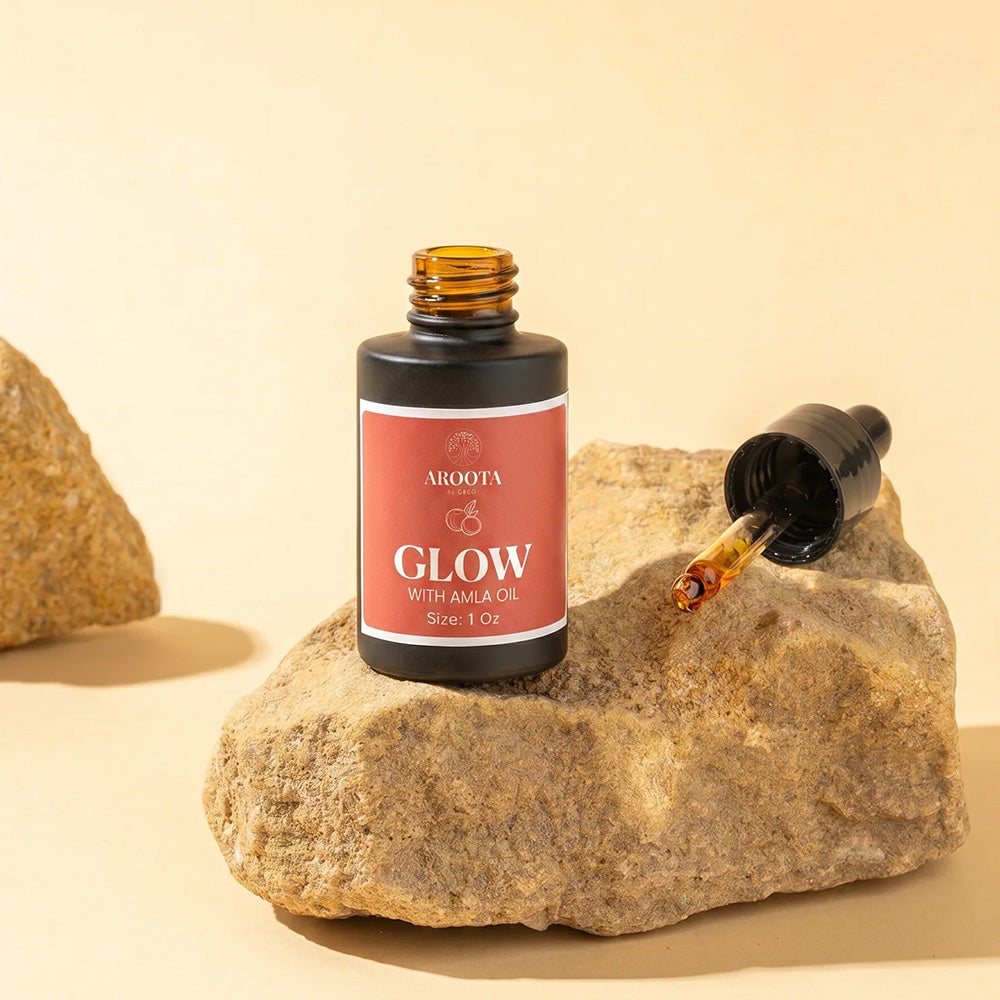
And I leaned into Vitamin C, which wasn't the ingredient I expected to reach for. But perimenopausal skin doesn't just get dry — it gets a little dull, a little uneven, the kind of tired that a heavier cream alone doesn't fix. My Glow Vitamin C Serum — the oil-soluble, Amla-based version I built specifically because the usual Vitamin C serums stung and oxidized before I could even finish the bottle — became the thing that made my skin look like mine again, underneath all that dryness.
Cleanse gently. Nourish before you treat. Let the ritual be slow enough that it actually feels like care, not maintenance. Somewhere in that first month of the new routine, I noticed it without looking for it — my hands didn't catch rough against my son's cheek anymore.

Ingredients to Look For (and Skip) During Perimenopause
These days I read labels differently than I used to, so here's what I actually reach for and what I've quietly stopped buying.
Lean toward: oil-based serums and balms, ghee, minimal-ingredient formulas, anything free of synthetic fragrance and endocrine disruptors — which matters even more once your hormones are already shifting on their own without help from a product.
Ease off: foaming sulfate cleansers, high-alcohol toners, aggressive exfoliating acids, and heavily fragranced lotions. All of it used to sit in my own cabinet. All of it was quietly pulling moisture my skin couldn't spare anymore, while I kept assuming the problem was that I wasn't doing enough.

Frequently Asked Questions
Is itchy or rough skin a real symptom of perimenopause? Yes. Declining and fluctuating estrogen affects collagen and the skin's moisture barrier, which commonly shows up as dryness, roughness, and itchiness with no rash or visible cause. If it's severe or comes with other symptoms, it's worth ruling out other causes with your doctor — that's not a formality, it's what I did too.
How long does perimenopause skin dryness last? It varies. For some women it eases once hormone levels stabilize post-menopause; for others, ongoing barrier support becomes a permanent part of the routine. I'm still somewhere in the middle of figuring that out myself.
What's the best natural remedy for perimenopause dry skin? Oil-based, barrier-supporting formulas applied consistently plus keeping your cleanser gentle rather than stripping is the traditional Ayurvedic answer, and it lines up with what dermatology generally recommends for barrier repair. It's what worked for me, and it's the same logic I built into this brand.
Can skincare alone fix perimenopause itchy or dry skin? Skincare can meaningfully ease dryness and support the barrier, but it isn't a substitute for medical care if the itching or roughness is severe or persistent. Think of it as one part of a bigger picture that includes sleep, diet, and your doctor's input.
I don't think perimenopause is a problem to solve. I think it's a chapter, the same way pregnancy was, the same way my 20s were just one my skin happened to announce before the rest of me caught up, in a school parking lot of all places. That's really the whole reason Aroota exists: not to promise you'll look like you're 25 again, but to hand you something gentle enough to trust while your body figures out what it needs next.
If your skin has started feeling like a stranger's too, I'd love to hear about it. Comment to this, I read every one.
— Ruchita
This is a personal account, not medical advice. If your dryness or itching is severe, sudden, or accompanied by other symptoms, please see your doctor before assuming it's "just hormones."

Leave a comment
This site is protected by hCaptcha and the hCaptcha Privacy Policy and Terms of Service apply.